Loading
Model 4

The Value Hierarchy Model

Model 4: The Value Hierarchy Model

Not all customer needs carry the same weight. Some are baseline expectations. Others are the reasons a customer stays, advocates, and refuses to switch. Understanding the difference is what separates brands that compete on price from those that compete on meaning.

The Value Hierarchy organizes customer needs and motivations into four levels. Like Maslow's hierarchy of needs, each level builds on the one below it. A brand that understands the hierarchy will have the power to influence its customers by tailoring its messages to the right needs.
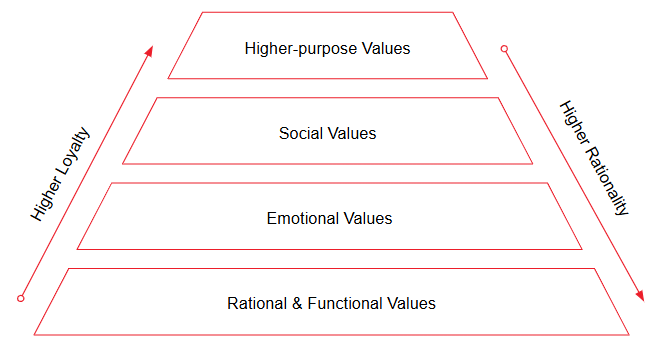
The value hierarchy model explains the 4 layers of customer values: rational and functional, emotional, social, and higher purpose.

  1. Rational & Functional Values.

    This layer fulfills the basic consumer needs in a product or service: quality, reliability, price, convenience, etc. A brand that doesn't deliver rational and functional values will not resonate with the consumer's rational mind.

  2. Emotional Values.

    Beyond function, customers respond to how a brand makes them feel. Enjoyment, confidence, attractiveness, or nostalgia; emotional values create attachment. A business that meets functional needs but generates no emotional connection is vulnerable to any competitor that does.

  3. Social Values.

    At this level, the brand becomes a part of the consumers identity. Customers are not only buying a product or service; they are associating with something that reflects them, their affiliations, or their standing within a community or peer group. Social values are powerful drivers of loyalty and word-of-mouth.

  4. Higher-Purpose Values.

    The most durable form of brand value. When a brand stands for something that transcends the transaction; a genuine commitment to a cause, a community, or a deep transition within oneself, it creates connection that is difficult to replicate and even harder to displace.

The hierarchy works in two directions. Higher-purpose brands retain customers with higher loyalty. Brands that earn trust at the rational level before building upward do so with higher credibility. The strategic question is not which level to occupy, it is how to build consistently from the ground up.